
In the fast-moving world of AI, we’re used to the heavyweight title bouts happening in Silicon Valley. But while everyone was distracted by the latest from San Francisco, a Tokyo-based startup called Sakana AI just pulled off a stunning upset that has the industry reeling.
They’ve launched a system called Fugu, and according to recent benchmarks, its “Ultra” version isn’t just competing with the best — it’s actively outperforming Anthropic’s most powerful (and recently restricted) models, Claude Fable 5 and Mythos.
Table of Contents
The Stealth Rise of Sakana AI
Sakana AI isn’t your typical underdog. Founded in 2023, it’s led by Llion Jones, a co-author of the foundational Google paper “Attention Is All You Need,” and David Ha, the former head of research at Stability AI. The name Sakana means “fish” in Japanese, and their logo — a school of small fish forming one large fish — is the perfect metaphor for their breakthrough.
How Fugu Did the Impossible
What makes Fugu so disruptive is that it isn’t a single, massive Large Language Model (LLM) in the traditional sense. Instead, it is a multi-agent orchestration system.
Think of it like a conductor leading a world-class orchestra. The Fugu system uses a “manager” model trained specifically to break down complex tasks and delegate them to a pool of specialists. It might send a coding task to GPT, a writing task to Claude, and a research task to Gemini, then synthesize the results into one perfect answer.
Because it can orchestrate these models dynamically, it achieves “frontier capability” without the same export controls that have recently hampered US-based models.
The Benchmarks: Beating the “Unbeatable”
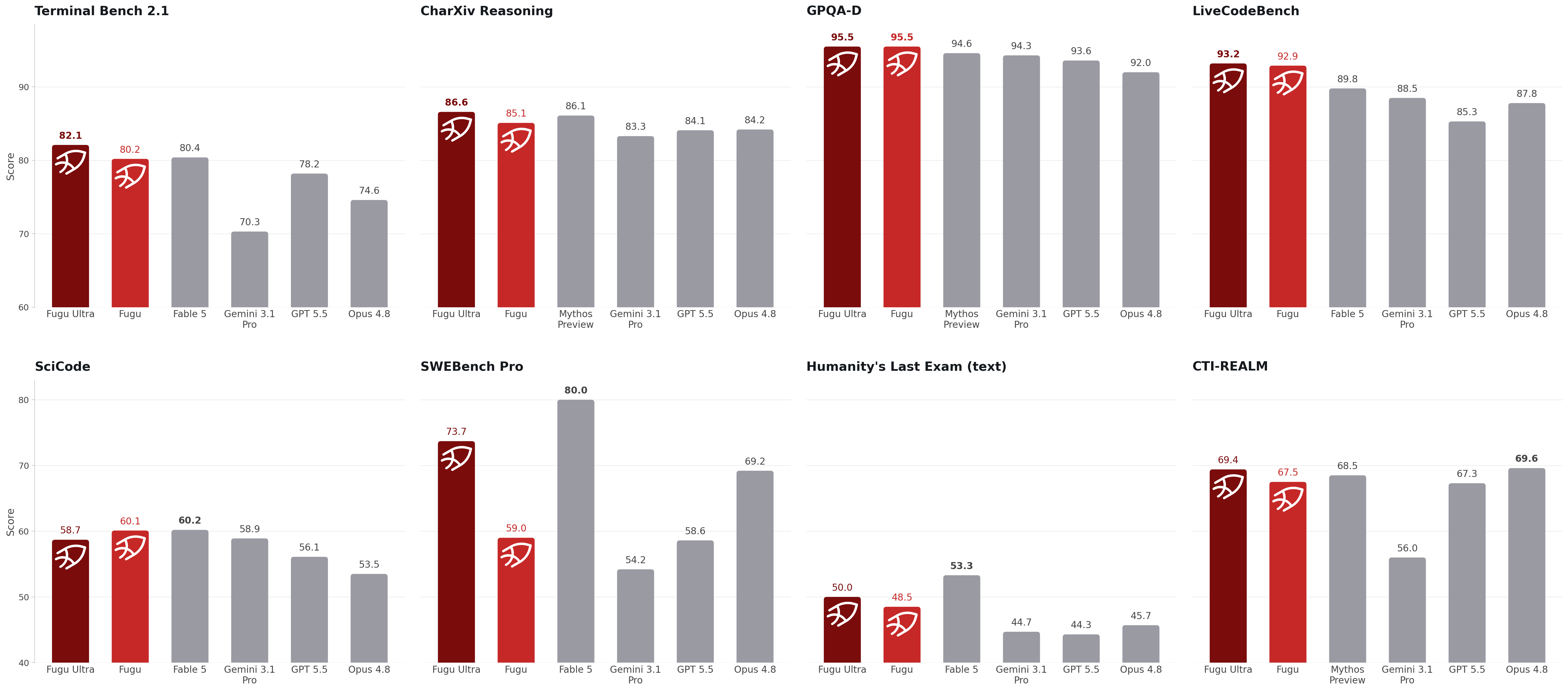
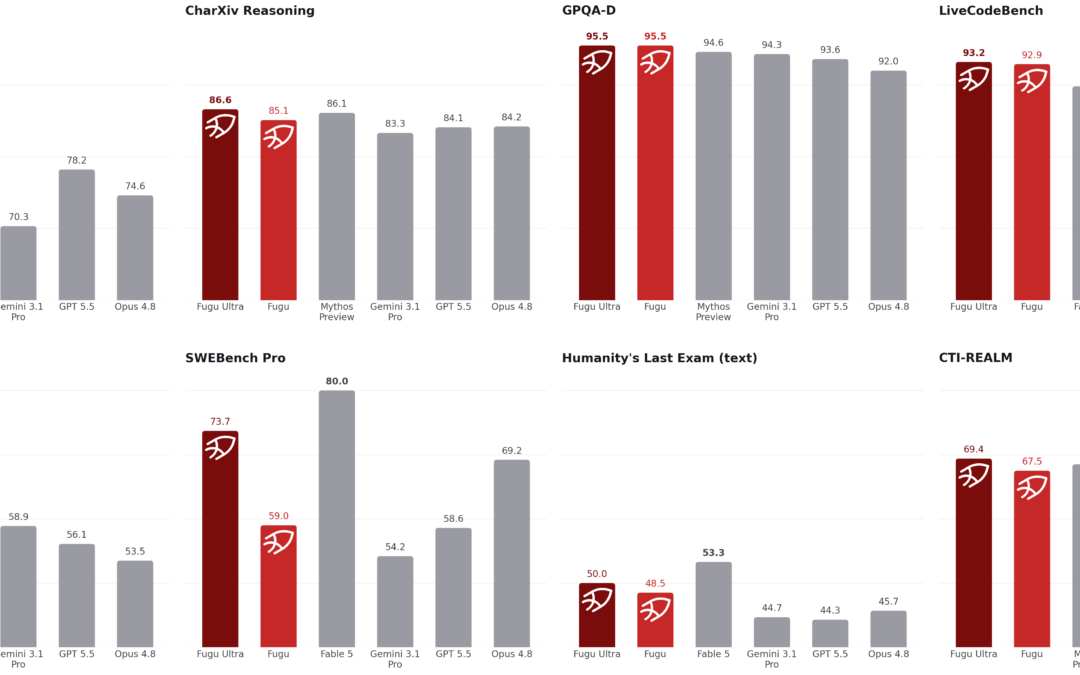
The numbers coming out of Sakana’s labs are hard to ignore. On LiveCodeBench, which tests regularly refreshed software problem-solving tasks, Fugu Ultra scored 93.2, edging out Claude Fable’s 89.8.
Even more impressive was its performance on GPQA-D, a rigorous test involving 198 graduate-level science questions in physics, biology, and chemistry. Fugu Ultra scored 95.5, surpassing the Claude Mythos Preview score of 94.6.
This is particularly significant because Fable 5 and Mythos were recently rolled back by Anthropic following US government national security concerns. Sakana has essentially stepped into the vacuum left by these restricted models.
The Reality Check: Is it Too Good to be True?
While the benchmarks are historic, real-world “battle testing” reveals some significant trade-offs. Independent testers have noted that because Fugu is orchestrating multiple high-end models, it comes with a “tax” on both time and money.
- Speed: In head-to-head tests against Claude Opus 4.8, Fugu was roughly 4.5 times slower.
- Cost: Because it calls multiple APIs to solve a single problem, it can be 5 times more expensive than using a single frontier model.
- Intelligence: Critics argue that Fugu is more of a “smart harness” than a new form of raw intelligence. Since it relies on other models like GPT-5.5 or Opus 4.8 for its “thinking,” its power is fundamentally tied to the availability of those underlying systems.
Why This Matters
Regardless of the current costs, Sakana AI has proven that orchestration might be the new frontier. By focusing on how models work together rather than just building one giant “god-model,” they’ve found a way to squeeze superior performance out of existing tech.
Japan just showed the world that you don’t need to build the biggest model to win the benchmark war — you just need to be the best at managing them. As the AI landscape becomes more fragmented with various providers and export restrictions, the ability to optimize across “all the worlds” of AI will become a vital skill.
Nobody saw Japan coming for the crown, but with Fugu Ultra, Sakana AI has officially put the world on notice.